• How Often to Rotate Tires

    You should rotate your tires every 5,000 to 7,500 miles to keep them wearing evenly and maintain safe handling.

    If you drive mostly in the city or notice uneven tread or vibrations, you might need to rotate sooner. Smooth highway driving can stretch that interval a bit.

    Always check your owner’s manual for vehicle-specific guidance, as it overrides general advice.

    Proper rotation not only extends tire life but also preserves your vehicle’s performance. There’s more to learn about patterns and timing that can help you get the best results.

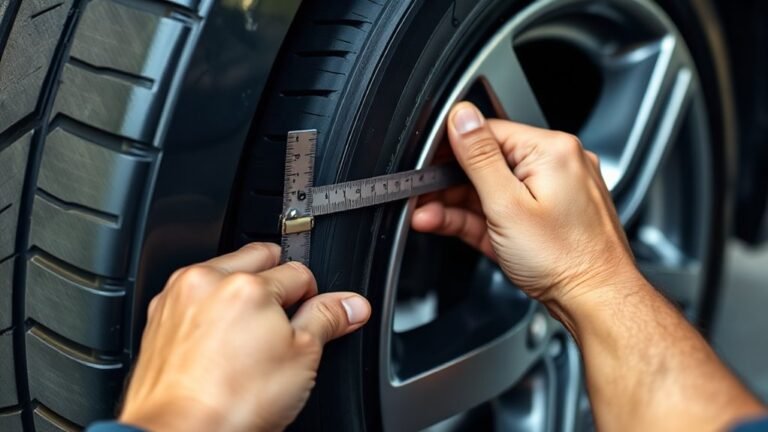
  • How Long Can You Drive on a Spare Tire?

    You can drive on a spare tire safely for 50 to 150 miles, depending on its type. Compact “donut” spares typically limit you to about 50–70 miles at speeds under 50 mph.

    Full-size spares allow longer distances and slightly higher speeds. Run-flat tires also have moderate limits. Driving beyond these limits risks traction loss and damage.

    Knowing how far and how fast to go helps keep you safe and your vehicle stable. Learn more about care and precautions to extend your spare’s usefulness.

  • How to Check Tire Size in 7 Steps

    To check your tire size in 7 steps, start by locating the raised numbers on your tire’s sidewall after cleaning it. Decode the size code—like P215/65R15—identifying tire width, aspect ratio, and construction type.

    Make sure to verify the rim diameter matches your wheel. Then, compare these specs to your vehicle’s manual or door sticker.

    Don’t forget to check the load index and speed rating to guarantee safety. Finally, use online tools for quick accuracy and expert recommendations.

    Keep going to get all the details you need!

  • How Often Should You Rotate Your Tires?

    You should rotate your tires every 5,000 to 7,500 miles to keep them wearing evenly and driving safely. If you do a lot of stop-and-go driving or carry heavy loads, stick closer to 5,000 miles.

    For mostly highway driving, you can stretch it to 7,500 miles. Rotating tires regularly helps improve handling, traction, and fuel efficiency while extending your tire’s life.

    Keep an eye out for signs of uneven wear, and learn the best patterns and tips to make the process easier. It’s not too hard once you get the hang of it!

  • How Often to Rotate Tires?

    You should rotate your tires every 5,000 to 7,500 miles to guarantee even wear and extend their lifespan. If you drive on rough roads or carry heavy loads, rotate them more often.

    Watch for signs like uneven tread wear, steering vibration, or pulling to one side. Rotation also improves safety and fuel efficiency.

    Following your vehicle’s recommendations and proper rotation patterns keeps your tires in good shape. Learn how to spot signs and choose the right rotation pattern next.

  • How to Remove a 70MAI Dash Cam From Windshield in 5 Steps

    To remove your 70MAI dash cam, first park on a flat surface and turn the cam off. Then, unplug the power cable gently.

    Next, locate and press the small latch on the mounting bracket to release it without forcing. Hold the cam firmly and twist or slide it off carefully.

    You can use a plastic card if needed to lift adhesive pads without scratching the glass. Finally, clean the windshield and check your mounting gear if you plan to reinstall.

    Keep going to guarantee a smooth, damage-free removal.

  • 7 Steps to Prevent Dash Cam Draining Battery

    To prevent your dash cam from draining your car battery, start by choosing a low-power model with energy-saving features and a built-in battery or capacitor. Adjust parking mode settings to lower sensitivity and shorten recording times.

    Use a hardwire kit with battery protection and plug it into a fuse slot that cuts power when voltage drops. Set a timer to auto-shutoff, monitor your battery health regularly, and turn off the dash cam when not in use.

    Following these steps will help you keep your battery strong and reliable. It’s all about making smart choices and staying on top of your settings. That way, your dash cam won’t drain your battery when you least expect it.

  • How Long Does Red Tiger Dash Cam Keep Footage?

    Your Red Tiger dash cam typically keeps footage for three to seven days by using loop recording that overwrites the oldest videos once storage is full. How long your clips stay depends on your driving frequency, video resolution, and memory card size.

    Higher quality videos and longer drives fill space faster, causing quicker overwrites. If you want to protect important moments and avoid storage issues, understanding these factors and managing your files properly will help.

  • How Dash Cams Improve Vehicle Safety in the USA

    You can boost your vehicle safety by using dash cams that automatically record wide road views and save impact moments with G-sensors. They capture clear, timestamped footage that helps prove fault and prevent false claims in accidents.

    Dash cams also discourage reckless driving by promoting accountability and safer habits. Choosing features like night vision and loop recording guarantees continuous protection.

    If you want to see how dash cams lower insurance rates and fit different vehicles, keep exploring.

  • Does Verizon Connect Dash Cam Record Audio?

    Yes, your Verizon Connect dash cam records audio whenever it’s active, capturing conversations, road sounds, and more to provide a full driving environment record.

    You can easily toggle audio on or off through the device settings. But keep in mind, you’ll need to notify people in the vehicle due to privacy laws.

    The clear, synchronized audio helps with security and accountability. There’s additional info about privacy policies, controls, and legal considerations to explore.